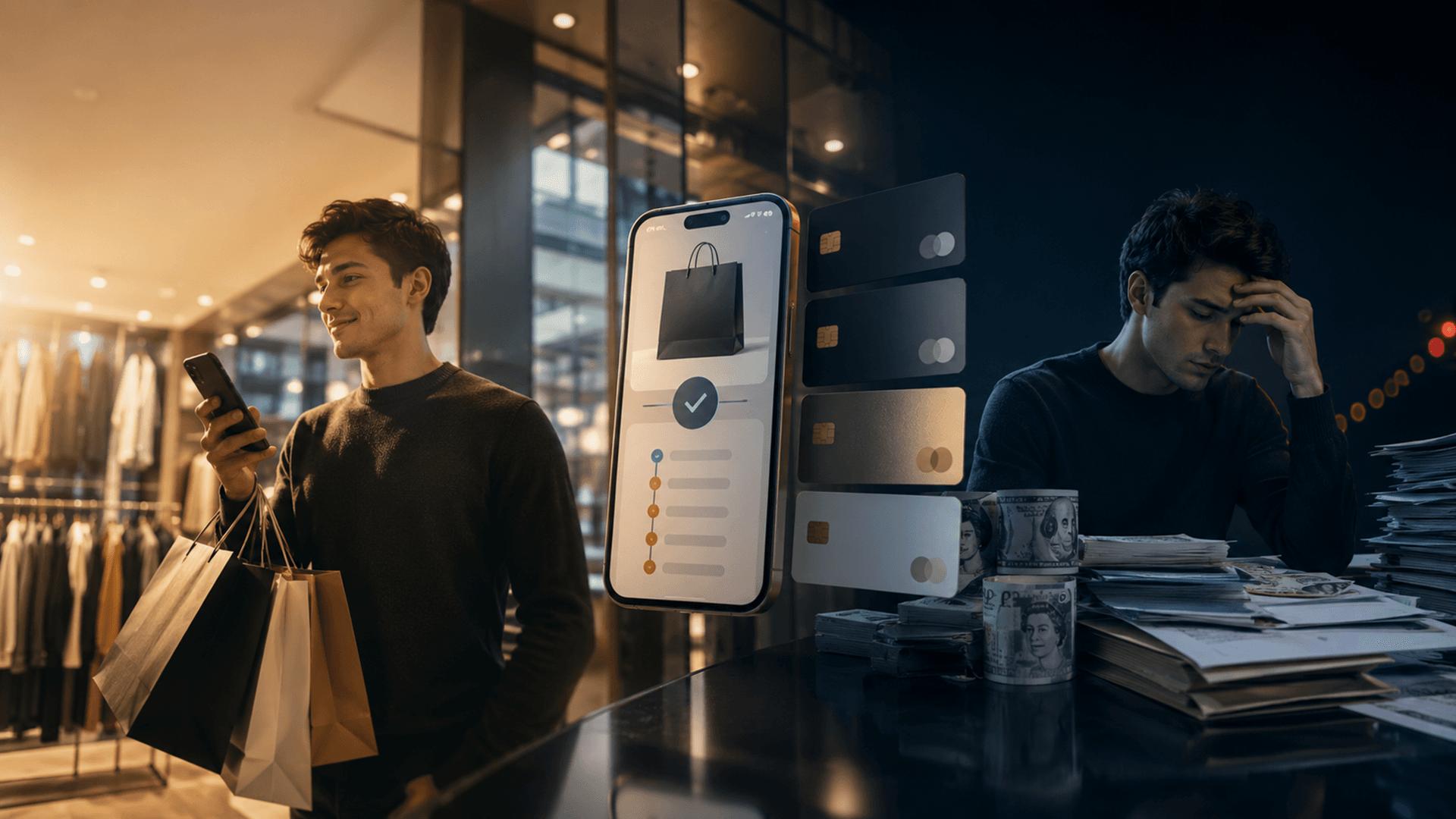

What Is Buy Now Pay Later?
Buy Now Pay Later (BNPL) is a short-term financing option that lets you split a purchase into smaller instalments — typically three or four equal payments — spread over a few weeks or months. Unlike a traditional credit card, most BNPL products charge zero interest if you pay on time, and the approval process takes seconds at checkout.
BNPL providers make their money primarily from merchants (who pay a fee per transaction in exchange for higher conversion rates) rather than from consumers. This is what allows the basic product to be free for shoppers — at least on the surface, and at least when used as intended.
In 2026, BNPL is firmly mainstream. Klarna, Afterpay/Clearpay, PayPal Pay Later, Affirm, and Zip process hundreds of billions of dollars and pounds in transactions annually. You'll find BNPL options at major retailers, travel booking sites, healthcare providers, and even utility companies. Understanding exactly how it works — and where the risks lie — is increasingly important for everyday financial decisions. For broader context on where BNPL fits in the financial technology landscape, see our guide on what fintech is and how it works.
How BNPL Actually Works
The mechanics are straightforward but worth understanding clearly:
- You select BNPL at checkout — either on a retailer's website or in-store via a virtual card or QR code.
- Instant soft credit check — the BNPL provider runs a quick assessment (usually a soft search that doesn't affect your credit score at this stage) to approve the transaction.
- You pay the first instalment immediately — typically 25% of the purchase price. The retailer receives the full amount from the BNPL provider.
- Remaining instalments are collected automatically — debited from your debit or credit card every two weeks (for a four-payment "pay in 4" plan) or monthly for longer-term financing.
- No interest if paid on time — for standard short-term plans. Longer-term financing products from the same providers often do charge interest.
The key distinction is between short-term BNPL (typically 6 weeks for "pay in 4") and longer-term instalment loans (3–36 months) that the same platforms offer. The former is generally interest-free; the latter is a conventional credit product with APRs that can be significant. Reading which product you're actually signing up for is important.
Major BNPL Providers in the US and UK (2026)
| Provider | Market | Standard Product | Interest-Free? | Late Fee? |
|---|---|---|---|---|
| Klarna | US & UK | Pay in 3 (UK) / Pay in 4 (US) | Yes (short-term) | Yes (UK: up to £5/charge) |
| Afterpay (US) / Clearpay (UK) | US & UK | Pay in 4 fortnightly | Yes | Yes (capped) |
| Affirm | US | Pay in 4 or monthly | Pay in 4: yes; monthly: 0–36% APR | No late fees |
| PayPal Pay Later | US & UK | Pay in 3 (UK) / Pay in 4 (US) | Yes (short-term) | No |
| Zip (formerly Quadpay) | US | Pay in 4 | Yes | Yes |
Note: product terms change frequently. Always check current terms on the provider's website before using.
The Real Pros of BNPL
Interest-Free Cash Flow Flexibility
For a purchase you were going to make anyway, splitting it into four interest-free payments over six weeks costs nothing extra and preserves cash in your account in the interim. If your income is monthly but an expense falls awkwardly mid-cycle, BNPL can smooth the timing without any financial cost — provided you pay on time.
No Hard Credit Check for Basic Products
Most standard short-term BNPL plans use a soft credit check for the initial approval, which doesn't affect your credit score. This makes BNPL accessible to people who may not qualify for a credit card, and convenient for people who don't want an unnecessary hard inquiry on their credit report.
Faster and Simpler Than Credit Applications
A BNPL approval happens in seconds at checkout. There's no lengthy application, no documentation required, and no waiting period. For time-sensitive purchases, this is genuinely more convenient than applying for a credit card or personal loan.
Can Aid Budgeting for Necessary Large Purchases
For essential purchases — a new laptop for work, a boiler replacement, essential dental work — BNPL can spread a large one-off expense without interest, which is superior to putting it on a credit card that charges 20%+ APR. Some healthcare providers and professional services now accept BNPL specifically for this reason.
Doesn't Affect Credit Card Utilisation (Usually)
Because BNPL is a separate credit product (not a revolving credit line), it typically doesn't affect your credit card utilisation ratio — one of the factors in your credit score. Keeping your credit card balance low while using BNPL for a purchase can be credit-score neutral if managed correctly.
The Real Cons of BNPL
Encourages Overspending and Impulse Purchases
BNPL's design is optimised for conversion at checkout. By reducing the perceived immediate cost of a purchase (£200 becomes "just £50 today"), it lowers the psychological barrier to spending. Research consistently shows that BNPL users spend more per transaction and make more purchases than they would without it. The product is specifically engineered to feel less like borrowing — which means it's easier to accumulate multiple simultaneous obligations without a clear picture of total debt.
Multiple Plans Are Hard to Track
There's no single statement showing all your BNPL obligations across providers. Someone using Klarna for one purchase, Afterpay for another, and PayPal Pay Later for a third simultaneously has three separate repayment schedules coming from their account on different dates. Missed payments on any of them can trigger fees and, increasingly, credit reporting consequences.
Late Fees and Penalty Consequences
Most BNPL providers charge late fees when payments are missed — typically £5–£25 per missed payment in the UK, with varying caps in the US. While these sound small, they represent a significant effective interest rate on small purchases. A £5 late fee on a £50 payment is effectively a 10% charge for one missed instalment.
More significantly: as regulation has tightened in both the US and UK, BNPL providers are increasingly reporting late payments and defaults to credit reference agencies. A missed BNPL payment can now appear on your credit report in many circumstances, potentially affecting your ability to get a mortgage or other credit.
Longer-Term Products Carry High APRs
The interest-free short-term plan gets most of the attention, but the same platforms offer longer-term financing at rates that can be significantly higher than conventional credit. Affirm's monthly plans can carry APRs of up to 36%. Klarna's financing products in some markets charge substantial rates. Consumers who don't distinguish between the "pay in 4" product and the "pay over 12 months" product can end up with expensive debt.
Historically Weaker Consumer Protections
In the UK, BNPL products have largely sat outside FCA regulation — meaning they've lacked the protections that apply to credit cards (like Section 75 protection, which makes the lender jointly liable for purchases over £100 if a retailer fails). This is changing: UK regulation of BNPL is now in progress, with formal FCA oversight expected by 2026–2027. In the US, the CFPB has issued guidance treating BNPL providers more like credit card issuers. The regulatory landscape is evolving, but protections still lag those for traditional credit in many cases.
Can Complicate Returns and Refunds
Returning a BNPL purchase doesn't automatically pause your repayment schedule. In most cases, the refund goes back to the BNPL provider, who then adjusts or cancels the remaining instalments — but timing gaps can mean you continue being debited while waiting for the refund to process. This creates cash flow friction that doesn't exist with a straightforward credit card refund.
BNPL and Your Credit Score in 2026
The relationship between BNPL and credit scores has changed significantly and varies by provider and country:
- Soft checks at application — most short-term BNPL approvals use soft searches that don't affect your credit score. Longer-term financing typically involves a hard search.
- Reporting of on-time payments — some providers (Experian Boost in the US, some UK providers) now report on-time BNPL payments positively. This is not universal.
- Reporting of missed payments — this is where the risk lies. Missed payments are increasingly reported to credit bureaus (Equifax, Experian, TransUnion in the US; Experian, Equifax, TransUnion in the UK). A BNPL default can affect your credit score for up to six years in the UK.
- Visibility to mortgage lenders — UK mortgage lenders increasingly examine bank statements for BNPL usage and may view frequent BNPL use as a sign of financial stress, even if all payments were made on time.
BNPL: US vs UK Differences
| Factor | United States | United Kingdom |
|---|---|---|
| Major providers | Affirm, Afterpay, Klarna, Zip, PayPal | Klarna, Clearpay, PayPal, Laybuy |
| Regulation (2026) | CFPB oversight increasing; treated more like credit cards | FCA regulation imminent; currently limited oversight |
| Credit reporting | Varies by provider; Affirm reports to bureaus | Increasing; missed payments widely reported |
| Late fees | Varies; Affirm charges none | Most providers charge £5–£24 per missed payment |
| Consumer protection | CFPB protections applying; Regulation Z increasingly relevant | Section 75 does NOT apply; FCA protections pending |
How to Use BNPL Without Damaging Your Finances
BNPL isn't inherently harmful — it's a tool, and like most financial tools, outcomes depend on how it's used. A few principles for using it responsibly:
- Only use it for purchases you've already budgeted for — BNPL should split a planned payment, not enable a purchase you couldn't otherwise afford
- Track all active plans in one place — keep a simple note or spreadsheet of what you owe to each provider and when each payment falls due
- Don't use multiple plans simultaneously — stacking several BNPL commitments makes tracking difficult and can quickly create cash flow problems
- Set up automatic payments — missed payments are the primary risk; removing the human element removes most of it
- Read which product you're using — confirm whether it's the interest-free short-term plan or a longer-term instalment loan before committing
- Be aware of mortgage implications — if you're planning to apply for a mortgage in the near future, consider whether visible BNPL use on your bank statements could affect affordability assessments
Frequently Asked Questions
- Does using BNPL hurt your credit score?
- Used correctly (on-time payments, no missed instalments), BNPL typically has no negative impact on your credit score, and some providers now report positive payment history. The risk is missed payments, which are increasingly reported to credit bureaus and can remain on your file for years. Applying for multiple BNPL products in quick succession can also generate multiple soft or hard searches.
- Is BNPL the same as a credit card?
- No, though the distinction is narrowing as regulation tightens. A credit card is a revolving credit facility regulated as a credit product, with protections like Section 75 in the UK and CARD Act protections in the US. Most BNPL products are fixed instalment arrangements that have historically had fewer protections. The practical differences for consumers: BNPL is typically interest-free (short-term), faster to use, and has fewer regulatory protections — but this is changing as both UK and US regulators bring BNPL closer to the credit card regulatory framework.
- What happens if I can't make a BNPL payment?
- Most providers will charge a late fee and attempt to collect on the next scheduled date. If the account goes into persistent default, they may refer it to a debt collection agency and report it to credit bureaus. Some providers (notably Affirm in the US) don't charge late fees but still report defaults to bureaus. Contact the provider immediately if you're struggling — many have hardship arrangements available.
- Can I use BNPL for any purchase?
- BNPL is available at retailers and service providers that have integrated it — you can't use it anywhere a standard card is accepted. The range of available merchants has expanded significantly to include travel, healthcare, professional services, and home improvement, but it's still merchant-dependent rather than universally accepted.
- Is BNPL regulated in the UK and US?
- Regulation is in progress in both markets but not yet comprehensive. In the UK, the FCA is implementing formal oversight of BNPL under the Consumer Credit Act framework — legislation is expected to take effect in 2026–2027. In the US, the CFPB has issued interpretive rules treating BNPL lenders as credit card issuers under the Truth in Lending Act, requiring dispute resolution and refund rights. Both regulatory environments are tightening significantly compared to 2022–2024.
BNPL: Useful Tool, Real Risks
BNPL's core proposition — zero-cost instalment payments on purchases you were going to make anyway — is genuinely useful when used deliberately. The problem is that the product is designed to reduce friction at precisely the moment when financial friction is protective: the moment of purchase decision.
The risks are real: overspending, difficult-to-track multiple obligations, late fees, increasing credit score consequences, and weaker consumer protections than traditional credit. None of these are hypothetical — they're the documented outcomes for a meaningful proportion of BNPL users.
Used selectively, for budgeted purchases, with automatic payments and no simultaneous stacking of multiple plans, BNPL is a neutral-to-useful tool. Used as a habitual way to access spending you can't otherwise afford, it's a route to financial stress. The distinction is entirely in the user's approach. For more on the broader fintech landscape reshaping consumer finance, explore our Tech & Innovation guides and our coverage of the biggest fintech innovations reshaping finance in 2026.
Get practical fintech and personal finance insights delivered to your inbox — free.
Free forever. No spam. Unsubscribe anytime.

EzFinCode simplifies finance, investing, and technology for modern investors and entrepreneurs worldwide.